Sunday, 30 July 2017

Wemyss Caves; a Moment in Time.


Isn't it amazing how often we have something truly unique practically on our doorstep but somehow never actually go and see it?

I'm as guilty of that as anyone who reads this blog.  There are many wonderful places on the Fife coast of the Firth of Forth, and the Wemyss Caves are among them.  If you live in Fife, you will have heard of the Wemyss Caves.  You may not have paid much attention to what you heard because caves are just spaces worn, carved or eroded in walls of rock, right?  Well, maybe...

A few weeks ago I checked out Save Wemyss Ancient Caves Society's Facebook page https://www.facebook.com/SaveWemyssAncientCavesSociety/ and found out they were offering tours of the caves.  So, Reader, I booked a place and went.

The group met at the Primary School, and our guide took us down to the Shore and we walked towards the caves.

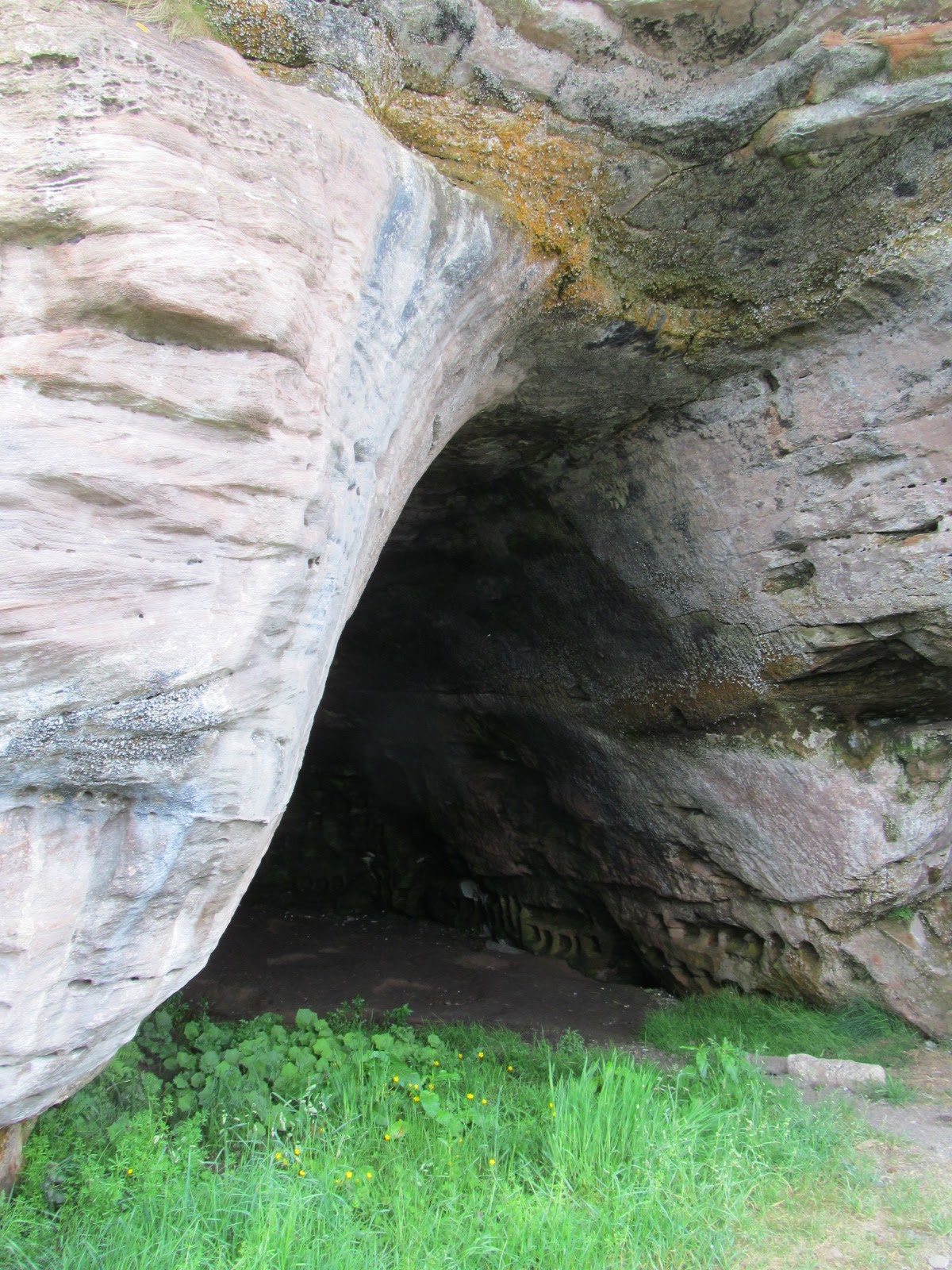
Wemyss Caves were formed by the action of the sea on the sandstone cliffs nine thousand years ago, and more caves were formed as the landmass rose. They have had many uses over the millennia as Law Courts, doocots and glassworks.

A large cave on the west side of the Michael Colliery housed the glassworks.  Glass was first produced here in 1610, and it was one of the earliest glassworks in Scotland.

The Michael Colliery shafts were sunk to the east of the cave in 1898 and the seams of coal under the cave were worked.  Thus, the cave was undermined and the cave collapsed with a load roar in 1901.

There are two ghost stories connected with the Court Cave.  It is also known as the Piper's Cave because a piper marched into the cave playing his pipes and was never seen again.  This legend of a smothered piper is  linked to Dairsie Castle, Culross and a cave in the cliffs of St Andrews.  In each case, a piper is said to have been exploring a tunnel while playing his pipes so that his progress could be traced.  The piping stopped, and, in every single case, instead of entering the cave to try to rescue him, observers waited a respectful time, then sealed the cave.  The other ghost is the White Lady, Mary Sibbald, who was the daughter of the Laird of Balgonie Castle.  She ran away with a gypsy.  The gypsy's jealous ex-girlfriend, Jean Lindsey, claimed that a piece of her jewellery had been stolen.  The jewellery was found underneath Mary's sleeping-mat where the ex-girlfriend had planted it., and Mary was
 ordered to have twelve lashes of the whip.  Mary is said to have died of a broken heart in the Well Cave.  On one occasion when a gypsy was lying about an innocent young girl in the Court Cave the words "you were a thief" rang out, and the ghost of the White Lady appeared and then disappeared.  She haunted the gypsies until Jean Lindsey admitted her guilt.  It is said that the White Lady can still sometimes be seen around the Castle and the Court Cave to this day.

 The Court Cave

At one point we climbed up to MacDuff Castle, home to Macbeth's Macduff and the place where his wife and sons were murdered by Macbeth

 Pictish markings in Wemyss Caves.  There are more Pictish markings in the Wemyss Caves than in all the other caves in Britain put together.  Over the years damage has been done to these caves by vandals and the Save Wemyss Ancient Caves Society was formed in 1986 to protect and preserve this important piece of Scottish heritage.  www.wemysscaves.org

Wemyss Caves, where you can look out from Pictish drawings towards modern technology.  Just one moment in time.

Thursday, 9 April 2015

The Last Bus Home


On April 1st I offered to write a fictional ghost story on my Facebook page.  Stories on the Original St Andrews Witches Tour are all traditional; handed down for centuries, and to mark April Fools day I thought it might be fun to write a totally made-up modern story.  I really should have thought that one through more carefully because, although I wrote it in the right order, each episode went on top of the previous one which made it read in reverse order.  Oops!

Anyway. this is a story about Isla, Ben and Bill.

The Last Bus Home

Isla's Story

I always get the last bus home from St Andrews on Friday nights.  Jamie, my fiance used to drive me home, but we split up a couple of years ago and because I don't have a car and never learned to drive, catching the bus has been my only option since then.  There wasn't anything remarkable about that particular Friday night.  Bill, the bus driver nodded at me as I got on the bus and I headed for my usual seat.

The bus jerked into motion and we slid past shops and houses.  I was the only passenger, as usual, until the  last bus stop on the very edge of town. That's where he got on.  Tall, with dark floppy hair and kind dark eyes that looked straight through me.  He was thrown into the seat across the aisle from me as the bus moved off again.  I glanced at him, then looked away quickly, in case he noticed.

Trees and houses and hedgerows slid by  as I sat in silence. I glanced sideways at him, wishing he would look over and notice me, but he just kept reading his book. I looked out of the window again. We were passing Magus Muir, where Archbishop Sharp was dragged from his coach and murdered. The road from here to St Andrews was supposed to be haunted by the Phantom Coach, though I'd never seen it.


Ironic, really, that so many people claimed to have seen a ghostly coach, yet here was I on a modern bus sitting across the aisle from an eminently fanciable guy, and I couldn't even get him to notice me.
I found that I was muttering under my breath. "Look over. Look at me. Notice me, for goodness sake. What's wrong with me?"
Then, finally, he looked...


Ben's story

What a night. Takeaway curry and a few beers with the flatmates, then a phone call from my girlfriend. She was at a birthday party in Anstruther, and did I want to come over?

I just had time to catch the last bus. I could have driven there, I suppose, but I wasn't sure I'd have passed the breathalyzser. So, bus it was. The bus stop is about a couple of hundred yards from the flat, and I got there in time to see the bus draw up.

It was just an ordinary bus. Nothing to mark it as unusual. I paid the driver, went towards the back of the bus, and sat down. Night-time bus journeys are always boring, so I got my book out of my bag and settled down to read.

You know how sometimes you feel like there are eyes boring into the back of your head? I got that feeling. After a while I couldn't ignore it any more, so I put my book down and looked around.
I wish I hadn't...


Bill's story


That Friday was much the same as any other. I was doing a late shift. The girl got on at the bus station, as usual. She's a quiet wee thing. Never draws any attention to herself. Usually sits about halfway up the bus. I don't have many regular passengers for the last bus on a Friday, but the people who catch the last bus tend to sit right at the back or just behind me.

When Ben got on the bus and picked a seat halfway down the aisle I could see him in the mirror, and I could see that Isla was giving him the glad-eye. He might not have noticed, but it was clear to me that Isla fancied him.

What was I supposed to do? I'm the seventh son of a seventh son. I have the clear sight. I didn't think that Ben would be able to see her, but I suppose after 30 years, Isla got lonely and wanted to be noticed. You see, Isla doesn't remember that she flung herself off the pier the night she was jilted, and she doesn't realise that she's dead, but the waves battering her off the rocks didn't do her any favours.
No wonder the laddie fainted when he saw her.

Wednesday, 11 September 2013

It's only superstion...


Superstitions may be irrational, inexplicable and deeply personal beliefs.  They come in all shapes and sizes, from "lucky pants" worn to an interview or football match, to not stepping on cracks in the pavement or avoiding looking at the new moon through glass without turning over the silver in your pocket to ward off bad luck.

Most superstitions seem to involve warding off bad luck by ritual (turning around clockwise three times and/or spitting) or by not bringing something "unlucky" into your life or your home.  Preventative ritual might include not walking under ladders or avoiding black cats, or even refusing to have certain plants in your home.

For some people, however, superstition can be a fixed point that is difficult to avoid.  Ladies and gentlemen, allow me to present "triskaidekaphobia", otherwise known as "fear of the number thirteen" to those of us fallible mortals who can't actually pronounce the word.  Ask me about  fear of the number thirteen and I will tell you that I laugh at triskaidekaphobia.  So does anyone in earshot when I try to pronounce the word.

In Italy, thirteen is considered to be a lucky number.  In many countries it's a number with no special relevance, lucky or unlucky.  In fact the number thirteen doesn't seem to have any importance in Britain until the seventeenth century.  So how did it get its bad reputation?

Some say that the number thirteen is considered to be unlucky because of its association with the Last Supper.  That's also probably where the superstition arose that if thirteen sit down to a meal, the last person to rise from the table will die within the year.

There are also thirteen lunar cycles, and therefore thirteen menstrual cycles in a year.  The Christian church also believed that a witches coven needed thirteen members to be effective.  Perhaps the association of the number with both the natural and the supernatural is why the number is considered sinister by some and the reason why some buildings don't have a thirteenth floor and some streets don't have a house numbered thirteen.

Triskaidekaphobia is disturbing enough for some people, but when the thirteenth of the month falls on a Friday anxiety levels can go through the roof. The day is named after Frigga, Norse goddess and wife of Odin.

Tradition says that Friday is an unlucky day to start a journey or a venture.  Seafarers would often refuse to set sail on a Friday and, even today, many people will try to avoid driving, flying or any unnecessary travel on a Friday.  Some people will even stay in bed all day to avoid bad luck.  If you're this fearful, what you're suffering from is "parakevidekatriaphobia " or "friggatriskaidekaphobia", but it's easier to say "fear of Friday the thirteenth".

On, the other hand, if you don't mind Friday the thirteenth, there's nothing like a ghost tour to defy the fates...

Thursday, 22 August 2013

Ghosts and Giggles

I very rarely manage to write anything on this blog in July or August.  I'm usually busy with family matters or other projects in those two months and, besides, July and August are the height of the tourist season which means the Original St Andrews Witches Tour is haunting the streets of the Home of Golf and there are phone calls to be made and answered, emails to be sent and costumes to be maintained.

Summer is also the time of year when new "jumpers-oot" learn to make a haunting impression on tourists; a time of year that can be really enjoyable or incredibly stressful for me, or often both at the same time.  I'm often asked what qualities a good jumper-oot needs.  The first one has to be a pulse.  Real ghosts are just so unreliable.  Vital signs aside, the ability to run at a brisk jog-trot at very least is necessary, as is imagination, but the absolutely essential quality in a good jumper-oot is a sense of humour.  Nothing will come together without that. After all, walking about town in a maxi dress needs a certain panache to carry off the look, especially if you're a guy who's over six foot tall and sporting a beard.

Everybody's first tour is a little nerve-wracking.  They wonder if they will remember the route, the cues, what they're supposed to do.  And so do I.  Everybody makes at least one mistake on their first tour, and it's my job to step in and make it look as if that's the way things are meant to be when it does happen.  Add to the mix the fact that the tours take place on the streets of St Andrews where truly strange things can (and do) happen, and it's very much a case of "expect the unexpected".


Strange things?  Well, several years ago I approached Martyrs' Monument to tell a story about the persecution of witches and noticed three figures sitting on one of the benches that used to be at the base of the monument.  It looked as if there was a woman in a tweed coat and a headscarf with a young man (students?) either side of her.  This was in November, and it was dark.  I led the twenty-or-so Scouts on the tour to the base of the Monument to tell the tale before I saw that the "woman" was wearing a duck mask under the headscarf.  I never did find out why but, whatever the reason, the Scouts stared at her unblinkingly for the next four or five minutes before I could finish my story and move them on.

Martyrs' Monument was a scene of consternation another time when the fire alarm went off in Patrick Hamilton Halls just as I approached the Monument.  My jumper-oot realised with horror that the fire point where people would gather was... yes... right next to the Monument, and he was desperately trying to tell people to "shhhh" so he could hear his cue.  I think the answers he got that night were pretty robust.  He did hit his cue, though.

There was also the night on the Bow Butts when I looked at one of the windows across the road and realised that four Santas were dancing in a circle in somebody's living-room.  To my eternal shame, I got the giggles and forgot what I was saying.

Over a few tours, jumpers-oot find their own way of doing things to make people on the tour scream and laugh.  By the second or third tour they are usually enjoying their work.  Such was the case with Jamie.  Hi, Jamie, if you're reading this!  Jamie was very shy when he started as a jumper-oot.  A quiet, polite boy who you would never imagine could want to frighten anybody.  Jamie got through his first tour without a mistake until the very last "jump-oot" when he came out of an alley dressed as the Beast and wearing a snake-head mask.  He did what he was supposed to do, and then ran off.

I started to laugh, and couldn't stop.  I couldn't stop laughing long enough to say my lines, couldn't see for tears of laughter.  In fact, I could barely stand for laughing.  It must have been over a minute before I could compose myself enough to explain to the baffled tour what I found so funny.  Just out of sight of the group, the alley Jamie ran down had a dog-leg turn.  Jamie knew this, but his view was limited by the mask, and, perhaps because of nerves, he had run off and straight into the wall.  The long snout of the mask had stopped him from hurting himself, but he had bounced off the wall with an audible, if muffled "Oof!"

By the time Jamie finished working on the tour and moved on to other things he had changed from that quiet boy to somebody who could control an audience, but every time I think of him I remember that "Oof!" and smile.

Tuesday, 11 June 2013

Ane Satyre of the Thrie Estaitis

A play that was first performed in 1540 before King James V of Scotland and his Queen, Marie de Guise might be presumed to be too staid for modern tastes, but the performances of A Satire of the Three Estates at Linlithgow Palace this weekend gave the lie to that presumption.

A Satire of the Three Estates was written by Sir David Lindsay of the Mount.  Sir David Lindsay owned land at the Mount near Cupar.  The Hopetoun Monument (shown below) is on this land.
Given that the 16th century was a time of deepening religious unrest in Scotland, it might be fair to expect the play to be mealy-mouthed and sanctimonious, but it is most decidedly neither of these.  Nor is it filled with "thee"s and "thou"s.  Although Auld Scots can be difficult to read, it springs to life when spoken aloud and most Scots will understand what David Lindsay was trying to say without too much effort.

The"three estates" of the title are the clergy, the nobility, and everybody else, and the play raises questions  as pertinent to politics in Scotland today as it did then.  The blog for the production can be found here 


Beautiful weather at Linlithgow Palace on Sunday was a decided bonus to this outdoor performance, and even the parliament of crows in the trees hit their cues on time.  Far from being staid and stuffy the performance was hilariously earthy and bawdy in parts and, at others it held a mirror to the state of politics today.  Eight hours flew past in a whirl of Vices, Virtues, political commentary and fart gags until, sunburnt and happy, the audience went home.
 
The last performance (of the Interlude) will be on Thursday, June 13th at Stirling Castle.

Thursday, 23 May 2013

Martyrs' Monument has stood on the Bow Butts on the Scores in St Andrews since it was first erected in 1842/3, a needle-like structure inscribed with the names of the Scottish Protestants who met with a martyr's death for their beliefs.  Patrrick Hamilton in 1528, Henry Forrest in 1533, George Wishart in 1546 and Walter Mill or Mylne in 1558.

A century and a half of exposure to the rain, wind and salt air, however had left the monument badly eroded, however, and a restoration fund was set up two and a half years ago.  Six months of hard work by skilled masons took place before the monument had its re-inauguration ceremony yesterday.
 
St Andrews Pipe band led guests to the bandstand 
It was a gloriously sunny, but very windy, day. Provost Jim Leishman welcomed those who came along on behalf of Fife Council and thanked those involved  in the restoration project.
Rev. Dr. Ian Bradley spoke of the history of the martyrs in St Andrews and how the Martyrs' Monument came to be built almost four centuries after Walter Mylne's death and two students from the University of St Andrews, dressed as early martyrs, barefoot and carrying bundles of wood, joined the party on the bandstand.  Dr Richard Holloway spoke of the meaning and significance of martyrdom in today's society, and then Rev. Rory MacLeod and Rev. Dr Andrew Kinghorn led prayers of reconciliation, and the event ended with a lone piper's lament


Friday, 1 March 2013

The most attractive village in Scotland?


This is the village of Ceres, which lies roughly three miles from Cupar and seven miles from St Andrews.  It has been called the most attractive village in Scotland.  I haven't seen all the villages in Scotland, but Ceres is certainly very pretty.  It nestles in a dip in a small valley and spreads below you as you follow the road to the right cresting the hill from Cupar.

In days gone by the village boasted several mills and there was coal mining close by, but today it is a dormitory town for people who work in Cupar, St Andrews, Perth and Dundee.

Nowadays it boasts a few local shops such as Hand Made Home 
Ceres Butchers
and Lunardi Gallery

Also Griselda Hill Pottery  which makes the famous Wemyss Ware pottery


Hostelries in the town are the  nineteenth-century Meldrums Hotel and the Ceres Inn which overlooks the Bow Butts, or village green.


Directly opposite the Ceres Inn , next to the antique shop, is a statue known locally as "The Toby Jug".  It is believed to represent the Reverend Thomas Buchanan, who was the last church provost in 1578, and just uphill from the Toby Jug is Fife Folk Museum


Across the road from the Bow Butts is the Bishop's Bridge, so called because Archbishop Sharp used it regularly when going between Kennoway and St Andrews.  He would have crossed this bridge on the 3rd May 1679 on his way to Magus Muir where he would be pulled from his coach and murdered in front of his daughter.

   Opposite the Bishop's Bridge is the Well House and its pump.


The Bow Butts has the name because that is where the youth of the town practised their archery skills in the 14th century.

Ceres is most famous for its free Highland Games which are said to be the oldest in Scotland.  The charter to hold the Games was awarded by Robert the Bruce in recognition of the villagers' suport in the Battle of Bannockburn on 24th June 1314, almost 700 years ago now, and the games have taken place every year since then except in time of war.

The war memorial facing the road in front of the Bow Butts is not a memorial to the soldiers of World Wars One or Two, however.  It is a memorial to the men of Ceres who marched away in 1314 to the Battle of Bannockburn, a battle which would shape how Scotland would be governed.


Most attractive village in Scotland?  Why not come along to the Ceres Games on the last Saturday in June and decide for yourself?

Sunday, 30 December 2012

Happy Hogmanay!


You'll notice that I didn't wish you a happy New Year in the title of this post.  That's because it's unlucky to wish somebody a happy New Year until after the Bells on January 1st.  The Bells, for those of you who aren't familiar with the expression, are not referring to the whisky but are the bells that ring out the old year and ring in the new at midnight between December 31st (Hogmanay) and January 1st (Ne'erday).

Hogmanay is traditionally associated with memories and endings.  Ne'erday is associated with new beginnings.  This is why people try to pay off any debts and attempt to finish any ongoing projects before the Bells; it allows them to begin the New Year with a clean slate.  In most towns people will gather at the Mercat (Market) Cross while a piper prepares to "pipe in" 2013.  After that has been done the crowd will wish each other a happy new year before dispersing to visit friends.

In Scotland we prepare for the New Year by cleaning the house.  That might be because it's considered unlucky to welcome the new year with a messy house but, more pragmatically, it's more likely to be because of the First Foots.  No, I don't mean First Feet; I mean First Foot.  The First Foot is the first person to set foot across your threshold after the Bells,bringing the New Year and its luck in with him or her.  The luckiest First Foot will be a dark-haired man, the least lucky a red-haired woman.  Don't get annoyed with me about that; I don't make up these superstitions. 

Tradition says that your First Foot should bring you a gift of oatmeal, coal or herring to bring plenty into your household and, for the same reason, you should ensure that all purses and pockets have a coin in them and that your food cupboards are stuffed full.  This symbolises a year of plenty ahead and makes sure that you have something to offer to family or friends who visit you during the New Year period.

Your First Foot will also bring gold (in the form of whisky) into your house and it is only good manners to accept a drink from them and offer one back, which, of course, leads to a party with singing and, occasionally, dancing.  This party may last an hour or may go on for a day, but the first song sung is usually "Auld Lang Syne".

Foodstuffs offered to First Foots may well include oatcakes, shortbread and Black Bun.  You may be familiar with the first two but not with Black Bun.  It is a very heavy and rich fruit cake encased in a pastry crust which may be used to sop up excessive alcohol or, alternatively, makes a useful doorstop.  It is an acquired taste... 

New Year celebrations may well go on for a couple of days and you will be wished a "Happy new year" by strangers you pass in the street.  Don't worry too much about traditions or superstitions (or even resolutions).  Just have a happy new year... when it comes.


Friday, 30 November 2012

Happy St Andrews Day

Who was St Andrew?  St Andrew was the brother of Simon Peter and was the first of the Apostles to follow Jesus.  He and Peter were invited to be "fishers of men" and after Jesus's crucifixion Andrew travelled along the coast of the Black Sea, preaching the Christian message.

This, predictably, didn't go down well with the pagan Romans, or the Emperor Nero.  Roman soldiers captured Andrew and crucified him at Patra, Greece on November 30th, AD 60, or so tradition has it.  Legend also says that St Andrew did not consider himself to be crucified on the same shape of cross as his Messiah and asked to be crucified on a crux decussata, the x-shaped cross that is now known as the Saltire.

Andrew is regarded as patron saint of fishermen, fishmongers and ropemakers.  He is also patronn saint of the Ukraine, Romania, Russia, Sicily, Greece, Cyprus, Barbados, Prussia and, of course, Scotland.

Scotland?  Yes, Scotland.  Although he never set foot in Scotland when he was alive, some of the bones of the saint were brought over to Scotland centuries ago.

Many hundreds of years ago a holy man named Rule lived in Patras in Greece.  One night an angel came to Rule in a dream and told him to "sail unto the ends of the Earth."  St Rule gathered some companions together and set sail.  He sailed round the coast of Spain, round the coast of France, and he was sailing round the East Neuk of Fife, still with no sign from God, when suddenly his prayers were answered and a great storm arose, and he was shipwrecked onto the shore in St Andrews Bay.

However, no sooner were Rule and his companions out of one danger, than they had landed in another, for, there, at the top of the shore, stood King Angus and his companions, ready to swoop down and plunder whatever they could.

Just then an angel rolled back the stormclouds and a great white cross slashed itself across the clear blue sky.  At that time there was no RAF station at Leuchars; no flying machines to make vapour trails.  There was no natural, rational explanation for this.  King Angus and his companions were so amazed that they dropped to their knees and converted to Christianity on the spot.  King Angus going further and granting a parcel of land to St Rule and his companions; land where the cathedral now stands, and there the relics stayed for many years until, during the Reformation, for safety's sake, they were moved, first to St Leonard's Hospital, which later became St Leonard's school.  They were then moved to the bishop's castle, but then they disappeared, and it's now believed that they lie somewhere within the vaults of the Vatican.

During medieval times St Andrews town was as important a place of pilgrimageas any other in Europe.

St Columba was originally regarded as the patron saint of Scotland, but in 832 AD, on the eve of the battle of Athelstaneford, King Angus II prayed for victory and declared that if his heavily-outnumbered forces won the following day he would declare St Andrew to be patron Saint of Scotland.

Next morning when the troops readied themselves for battle a huge white cross appeared over them in the sky, and the battle was won.

St Andrew's day has been an official bank holiday in Scotland since 2006 and is our national day when we celebrate all things Scottish.  Details of celebrations in St Andrews can be found at
http://standrewsfestival.org/

Wednesday, 25 July 2012

The Kingdom of Fife is beautiful in any weather; which is just as well considering the amount of rain that we've had this summer.  Last weekend I was out distributing leaflets for the Original St Andrews Witches Tour, and I found this scene in the town.  It was the weekend of the Big Tent Festival, Fife's eco-festival.

So, given that this month's #scotlandhour on Twitter is a discussion about Scotland's festivals, I thought it might be useful for visitors to Fife (and, indeed, Fifers themselves to be aware of just how many festivals the Kingdom hosts.

In January Burns Night is celebrated on the 25th with whisky, haggis and the Bard's poems.  Cupar in Fife is reputed to be the largest Burns' Club and there is a waiting list to attend their Burns' Night, but many hotels in Fife host Burns' Night celebrations that anyone can attend.

For music-lovers the Fife Jazz Festival is celebrated in many of the Kingdom's towns.  This year it was held on the 3rd to the 5th of February.

The Snowdrop Festival in Cambo lets you celebrate the joys of Spring in February and March, while March is also the time for St Andrews famous StAnza Poetry Festival and the relatively new St Andrews Golf Festival.

St Andrews Student Arts Festival "On the Rocks" was on 16-22nd April this year, and Crail Food Festival is held in June, as is the East Neuk Festival.  Further south in Fife, the Culross Festival is also held in June.

July brings T in the Park and St Andrews Inside Out Theatre and Outdoor Performance Festival which is held on the streets of St Andrews on July 27th - 29th.


Pittenweem's famous Arts Festival takes place on the 28th July - 5th August and, for those who love traditional Scots music the Auchtermuchty Festival takes place on the weekend10th - 12th of August. Dunfermline's Bruce Festival on the 25th -26th of August is a great famly event celebrating the town's history.

Autumn brings the new St Andrews Voices Festival which takes place on the 18th -21st October, and, of course, we on the Original St Andrews Witches Tour go a little crazy celebrating Halloween in October (and all year round for that matter)

The St Andrews Festival takes place on the 30th November to the 2nd December and marks the start of the lead up to the Festive season and, of course, Hogmanay, and if that lot hasn't tired you out, the cycle begins again with Burns Night the next year.

Oh, and who could forget the Highland Games that take place throughout the summer?  Ceres in Fife holds the oldest free Highland Games in Scotland.

I hope this helps you plan your visit to Fife so that you can see and experience some of what the Kingdom has to offer.

You may find details of other festivals elsewhere in Scotland if you check out #scotlandhour on the last Wednesday of the month on Twitter

Tuesday, 12 June 2012

June, Jubilee and Jubilations

"Ne'er cast a clout till May be oot."  That's what the old wives' tale says.  The May in question is the Hawthorn blossom and not the month, but both are still safely out now.  Very few people have cast any clouts, though; with the exception of a couple of weeks, this summer has been cold and wet.

Our Queen's Diamond Jubilee was a happy weekend, but mostly overcast or raining, and now the second big celebration of the summer approaches.  Yes; the 2012 Olympics.  Although London is a little remote from here the Olympic flame has been making its way through Scotland for the past few days and today it came into Fife.

The pictures here show ordinary people in an ordinary street in Cupar welcoming the flame as it enters the town.  No grandees, no grand speeches; just people of all ages showing goodwill and welcoming the flame as it makes its way towards the Olympic Stadium in London 


 These last three pictures are reproduced by kind permission of Karen Nichols of Scotia Heritage tours and show the torchbearers, 15-year-old Sula Powell and 20-year-old Lee Goodfellow.